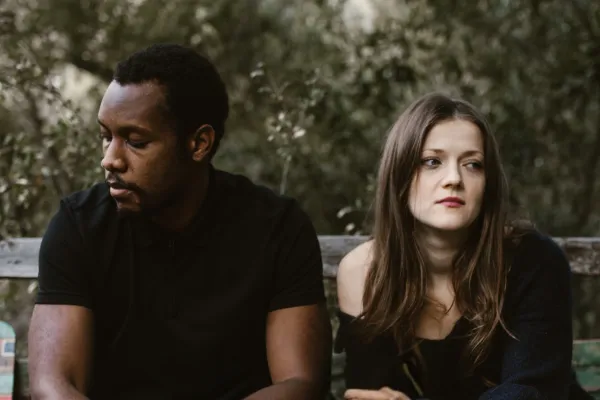
Why Do I Overreact Emotionally in Relationships?
You said something you didn’t mean. Or you shut down completely when all you wanted was to stay present. Maybe your partner said one small thing, and suddenly it felt like the walls were closing in. Now you’re sitting with that familiar, uncomfortable question: Why am I so emotionally reactive in relationships?
First, let’s reframe the word “overreact.” Your emotional reactions aren’t a character flaw or a sign that something is fundamentally broken in you. They make a lot more sense when you understand what’s actually happening underneath them. Deep within your nervous system, your relational history, and the survival parts of your brain that exist to keep you safe.
This post will walk you through why emotional reactions often feel bigger in relationships than anywhere else, what signs of emotional overwhelm actually look like, how your past quietly shapes your present, and, most importantly, what you can start doing about it.
Why Emotional Reactions Feel Stronger in Relationships
Relationships are the one place where your emotional reactions will always feel more intense, and that’s not a coincidence. It’s biology.
As humans, we are wired for connection and belonging as a survival mechanism. Our species isn’t particularly strong on its own; we thrive in community, and we always have. This means your brain and nervous system are constantly scanning your relational environment for signs of safety or threat. When a relationship attachment feels threatened, even in small ways, your system responds as if something essential is at stake. Because from an evolutionary standpoint, there is.
Here’s something worth knowing: current research in neuroscience shows that the same region of the brain that registers physical pain, like being stabbed, also registers relational rejection. So when you feel dismissed, abandoned, or disconnected from someone you love, your brain is not being “dramatic.” It literally processes physical pain and not belonging as one in the same, so the potential threat is very real.
This is especially true for people with attachment trauma histories. If you’ve developed anxious relational patterns over time, your nervous system is already primed to detect abandonment threats, and it will pick them up faster and more intensely than someone without that history. The emotional flood isn’t irrational. It’s your system processing your experience exactly the way it is designed to.
Common Signs of Emotional Overwhelm in Relationships
Emotional overwhelm doesn’t always look like a blowup. Sometimes it’s quieter than that, and harder to catch. Here are some of the most common signs:
Flooding. This is when a big, intense surge of emotion hits all at once and feels almost impossible to process in real time. You might feel your heart rate spike, your thoughts scatter, or your body tense. Flooding is your nervous system in a state of activation; it’s not weakness, it’s overwhelm.
Spiraling. A lot of clients describe this one. It’s when the mind starts running through every possible scenario, trying to find some sense of certainty, figuring out what went wrong, what it means, how to fix it, or prevent it from happening again. Spiraling is the mind’s anxious attempt to feel in control when the relational ground feels shaky.
Blending with the emotion. In IFS (Internal Family Systems) language, we call becoming so fused with the emotion that there’s no separation between you and it being “blended”. In this state, you don’t feel angry; you ARE angry. You don’t feel afraid; the fear IS you. When there’s no space between you and the emotion. Everything then feels too much, and with no clear way out, it can be quite overwhelming.
How Past Experiences Shape Your Emotional Reactions Today
One of the most important things to understand about emotional reactivity is that your reactions are rarely just about what’s happening right now. They carry history.
Early experiences with primary caregivers lay the foundation for how our nervous systems learn to relate. If you experienced abandonment, whether that was a parent leaving, a divorce, or simply not having a consistent emotional presence, your system learned to be on alert for those same patterns. The same is true for ongoing neglect, emotional immaturity in parents, or any form of abuse. These experiences aren’t just memories; they become relational templates that your nervous system carries forward.
And it doesn’t stop at childhood. Early romantic relationships also matter more than we often give them credit for. Those first experiences of intimacy, vulnerability, and heartbreak create an early romantic template that shapes how we show up in relationships well into adulthood. If your first significant relationship involved betrayal, rejection, or instability, those patterns are likely still running in the background.
From an interpersonal neurobiology lens, this makes complete sense. The brain is a pattern-recognition machine, and it uses past experiences to predict and respond to the present. When something in your current relationship echoes an old wound, even subtly, your system activates as if the original threat is happening again. This is what attachment wounds look like in real time.
How to Recognize Your Emotional Triggers Earlier
The honest answer here is that you can’t shortcut this part. Recognizing emotional triggers earlier requires getting curious about your own patterns, and that curiosity has to happen after the overwhelm has passed, when you’re back in a more regulated state.
When you’re calm, start to track your experience. What was happening right before the reaction? What story or narrative did your mind create in that moment? What did it mean to you? What did you feel in your body? This kind of mindful self-inquiry, bringing curiosity to your full experience rather than judgment, is how you begin to map your own emotional landscape.
Once you know your own sequence, the particular combination of sensations, thoughts, and narratives that show up right before you flood, you can start to catch it earlier in real time. You develop what we might call an “early warning system” for your own nervous system. That awareness creates a window of space where a different choice becomes possible.
Why Emotional Reactions Are So Often Followed by Shame or Guilt
Here’s something I see over and over again in my work: the reaction happens, and then the shame follows close behind. And the shame is often more painful than the original reaction.
Emotional overreactivity tends to come from a younger, more reactive part of us, which we might understand through an IFS lens as a protective or exiled part that carries old pain. But our more developed adult self looks back at those reactions and feels embarrassed. You know better. You’re a grown adult. You shouldn’t still be reacting this way. That gap between where you are developmentally and how you just behaved can feel enormous, and shame rushes in to fill it.
But here’s what I want you to understand: shame keeps you stuck. From an interpersonal neurobiology perspective, shame actively interferes with integration, the process by which our nervous system, brain, and relational patterns can actually change and heal. You cannot heal in a shame pit. There is no room to grow, no space to get curious, no capacity to hold yourself with compassion when you’re drowning in what’s wrong with you.
Self-compassion isn’t just a nice idea; it’s neurologically necessary for change. When you can hold your reactions with curiosity instead of contempt, you expand your capacity to understand yourself. And when you understand yourself better, you naturally expand your perception of others. That shift, from shame to curiosity, is often the first real step toward reducing emotional reactivity.
Small Ways to Build Healthier Emotional Responses Over Time
Building emotional regulation is a skill, and like any skill, it has to be practiced when you’re not in the middle of a crisis. Here’s why that matters: when we’re highly flooded, the parts of our brain responsible for reflection, nuance, and choice are essentially offline. You cannot learn a new skill during a flood. You can only access what you’ve already practiced.
A consistent mindfulness practice, even five to ten minutes a day, actually builds your emotional capacity over time. It expands your window of tolerance, which is the range of emotional intensity you can stay present with without shutting down or exploding. The wider the window, the more regulated you can stay in moments that used to overwhelm you.
Some other small but meaningful practices:
Notice your body first. Emotions live in the body before they become thoughts. Learning to track physical sensations, tension in the chest, a held breath, a tight jaw, gives you earlier access to what’s happening emotionally.
Name what you’re feeling. Research suggests that labeling emotions, even internally, can help reduce their intensity. “I notice I’m feeling scared” creates just enough distance to shift from blending to observing.
Replace shame with curiosity. When you catch yourself in the shame spiral after a big reaction, try asking: “What was that part of me trying to protect?” This small shift, from self-judgment to self-inquiry, opens the door to real understanding.
You Don’t Have to Figure This Out Alone
If you recognize yourself in any of this, the flooding, the shame spirals, the reactions that feel bigger than the moment, please know that this is some of the most common and workable territory in therapy. These patterns aren’t permanent. They’re learned, and they can change.
Couples therapy can be a powerful space to explore these dynamics together, with a therapist who can help both partners understand their own nervous systems, their relational patterns, and how to create more safety between them. When both people in a relationship start to understand what’s driving their reactions, and approach each other with that same curiosity instead of blame, something genuinely shifts.
If you’re in the Austin area and you’re ready to start doing this work, I’d love to connect. Learn more about couples therapy or book a consultation to take the first step.