
Therapeutic Massage in Austin
Less bracing.
More room to be.
Care for the shoulders that never quite drop. The jaw you catch yourself clenching. The discomfort you’ve gotten used to working around.
Care for the shoulders that never quite drop, and relief from the discomfort you’ve been working around.

Trauma-Informed
Individualized Care
Fascia & Nervous System Focused
Does this sound familiar?
You finally relax.
Your body doesn't.
You spend the day pushing through, barely noticing your tension until you turn your head, reach for something, or settle into bed.
Do you find yourself clenching, bracing, or feeling restricted in movements that used to feel fluid and easy?
Care for your reoccurring neck, back, or hip pain keeps getting pushed aside.
Maybe you’ve been working through difficult experiences in therapy, setting boundaries, and caring for yourself, yet you still struggle to feel comfortable in your body.
You want to move freely, rest comfortably, and feel connected to your body again.

Making Sense of The Tension
Your body has reasons for bracing.
You may understand what you’ve been through and still wonder why your shoulders won’t drop or your body won’t settle.
Stress and trauma can leave the nervous system more alert to danger, with muscles continuing to brace even when you consciously know you’re safe. These protective responses can become so familiar that you notice the discomfort without recognizing what your body is responding to.
Your muscles, fascia, and nervous system are interconnected. Fascia, the connective tissue surrounding muscles and other structures, contains sensory nerves that contribute to how you experience your body, including pain.
Emotional strain and physical discomfort can influence one another, making it difficult to untangle where one ends and the other begins. This doesn’t mean you’re failing to relax. Your body’s responses may make sense in the context of what it has had to navigate.
Indivudualized Therapeutic Massage
Care that responds to your body.
Melanie’s work brings focused attention to the fascia, the connective tissue that surrounds and connects muscles and other structures throughout your body, and nervous system, recognizing the relationship between physical tension, protective responses, and our capacity to settle.
Because these tissues work together, Melanie considers how tension and restricted movement may relate across areas, alongside the place where you feel discomfort.
She blends deep tissue massage, the John Barnes approach to Myofascial Release (MFR), and Craniosacral Fascial Therapy (CFT) into one individualized session.
Utilizing focused muscular work and gentle, sustained fascial techniques allow her to adapt the care to your concerns, sensitivity, and responses.
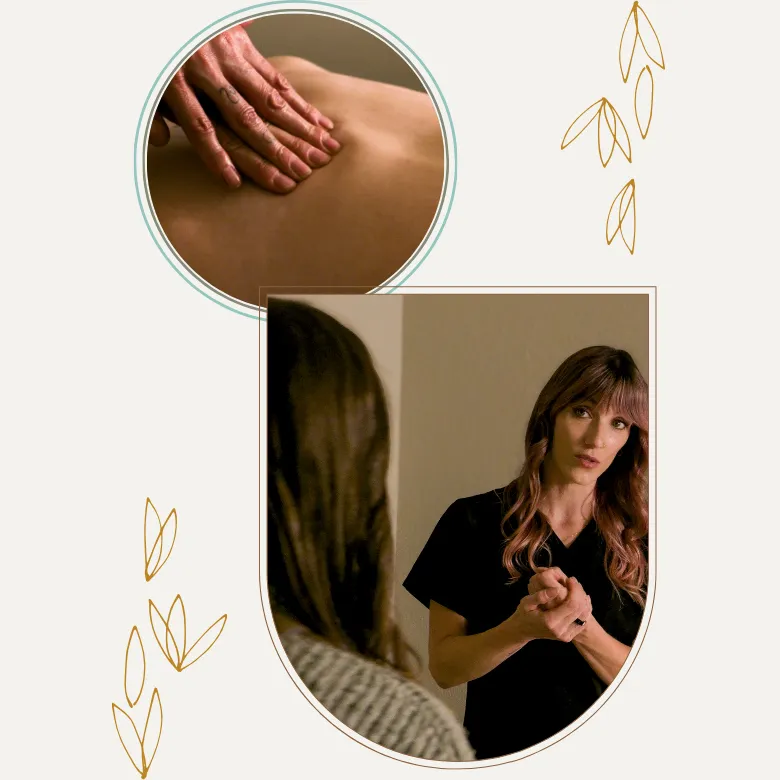
Trauma-Informed body work
Her trauma-informed approach recognizes that touch can feel comforting, unfamiliar, or vulnerable. Feeling respected and having choices are part of the care itself.
Melanie explains the proposed work, asks permission, and welcomes your feedback throughout.
Pressure, positioning, pacing, and areas of focus are discussed with you, and you are free to request changes, decline touch, or pause at any time.
This attention to your comfort and agency makes room for both physical care and the opportunity to settle, without expecting you to push through pain or override your body’s signals.
Your First Visit
Know what to expect.
1
Start with a conversation
Talk through your health history, current discomfort, and what you hope will change. Your first visit includes relevant assessment, treatment planning, and hands-on work.
2
Find an approach that fits
Melanie explains the proposed work and adapts pressure, positioning, and areas of focus with your input.
3
Keep your choices in the room
You can request adjustments, decline work on an area, or pause at any time. You do not need to disclose difficult personal experiences to have your boundaries respected.
Appointments & rates
Begin with care for your body.
Initial assessment & treatment
75 minutes
$140
Follow-up session
60 minutes
$140
Follow-up session
90 minutes
$195
No gratuity expected. In-person care in South Austin.
Why Body Work at Observant Mind?
Room for your story.
Release for your body.
Your emotional and physical experiences are connected. Our approach makes room to care for both.
Counseling offers space to work with the emotions, relationships, and protective patterns shaped by your experiences. Therapeutic massage provides hands-on care for physical tension, discomfort, and restricted movement.
For someone working through trauma, this can mean having support for both the meaning of what happened and the physical discomfort they’re living with now.
Each service has its own role: trauma-focused counseling addresses trauma symptoms, while massage offers complementary care for the body.
Across both, we value listening carefully, respecting your boundaries, and working collaboratively. Your choices about touch, pressure, pacing, and areas of focus remain part of the work throughout your massage session.
You can receive massage on its own or alongside counseling. You don’t need a trauma history or an existing therapy relationship to begin.

Meet Your Massage Therapist
Melanie Petrilli Barrett
Melanie is a Licensed Massage Therapist with training in the John Barnes approach to Myofascial Release and Craniosacral Fascial Therapy. Her background also includes holistic nutrition and health and wellness work.
She has a particular passion for helping women feel more comfortable and connected to their bodies. As a mother of two, she understands how easily caring for yourself can get crowded out by caring for everyone else.
Her approach brings together careful listening, individualized bodywork, and respect for your choices.
Room for your questions, too.
Do I need to be in counseling to book?
No. You can book massage on its own or receive it alongside counseling or other care.
What if I’m uncomfortable with touch or worried about pressure?
Tell Melanie what you’re comfortable with and what concerns you. She’ll discuss the approach before beginning, and your feedback remains part of the session. You do not have to push through pain.
How many appointments will I need?
There is no predetermined series everyone must complete. Recommendations depend on your goals, preferences, and response. Bodywork does not replace medical evaluation or rehabilitation when those are needed.
Therapeutic massage in South Austin
You don't have to keep
working around discomfort.
Begin with time to talk through what you're experiencing and hands-on care shaped around you.
jane awesome
acme co.
Highlight on what they loved about your product.
Mauris ac vestibulum nibh, quis euismod velit. Mauris sodales tincidunt ex vitae viverra. Nunc neque eros, convallis vel eros id, molestie bibendum neque. In hac habitasse platea dictumst. Integer quis hendrerit eros auris ac vestibulum nibh, quis euismod velit. Mauris sodales tincidunt ex vitae viverra. Nunc neque eros, convallis vel eros id, molestie bibendum neque. In hac habitasse platea dictumst. Integer quis hendrerit eros
Observant Mind
Integrative
Therapy + Wellness
South Austin
© Observant Mind | ALL RIGHTS RESERVED | TERMS & CONDITIONS
Good faith estimate | no surprises act | privacy policy